Ann Arbor’s residential landscape is one of the most varied in Michigan. Victorian and Craftsman homes from the late 19th and early 20th centuries line the streets of the Old Fourth Ward and Burns Park neighborhoods. Mid-century ranches and bungalows fill much of the city’s surrounding residential fabric. Contemporary infill construction and new developments are expanding the housing stock across Washtenaw County. Each cycle of residential redevelopment begins with the same first step: house demolition.
Whether you are a homeowner dealing with a structure damaged beyond practical repair, a developer planning an infill project on an established lot, or a builder preparing a parcel for new construction, understanding what residential demolition involves in Ann Arbor the types of demolition available, the regulatory requirements, the hazardous material considerations, and what the process looks like from start to finish is essential to planning your project effectively.
When Is House Demolition Necessary?
There are several common circumstances that lead Ann Arbor homeowners and developers to pursue residential demolition. Structural deterioration is among the most common: homes that have suffered long-term neglect, severe water damage, fire damage, or foundation failure may reach a point where the cost of repair exceeds the value of the repaired structure. In these cases, demolition and new construction is often the more sensible path.
Residential redevelopment is another significant driver. Ann Arbor’s desirable real estate market, particularly in close proximity to the University of Michigan campus and the downtown core, makes many older, smaller homes attractive targets for lot assembly and redevelopment. Developers purchase properties with the intention of demolishing existing structures and building new homes, duplexes, or small multifamily buildings that better meet current market demand and zoning allowances.
Estate settlement and property disposition sometimes result in demolition when inherited properties are in poor condition and heirs choose clearance over renovation. Similarly, homes that have been condemned by the City of Ann Arbor due to code violations or safety hazards may be subject to mandatory demolition if the owner cannot or chooses not to remediate the issues.
Partial demolition the removal of specific elements of a residential structure while leaving the main home intact is common in renovation projects. Removing an old garage, a deteriorated addition, a worn deck or porch, or a crumbling chimney are all examples of partial residential demolition that require professional equipment and, in many cases, a building permit.
Types of Residential Demolition
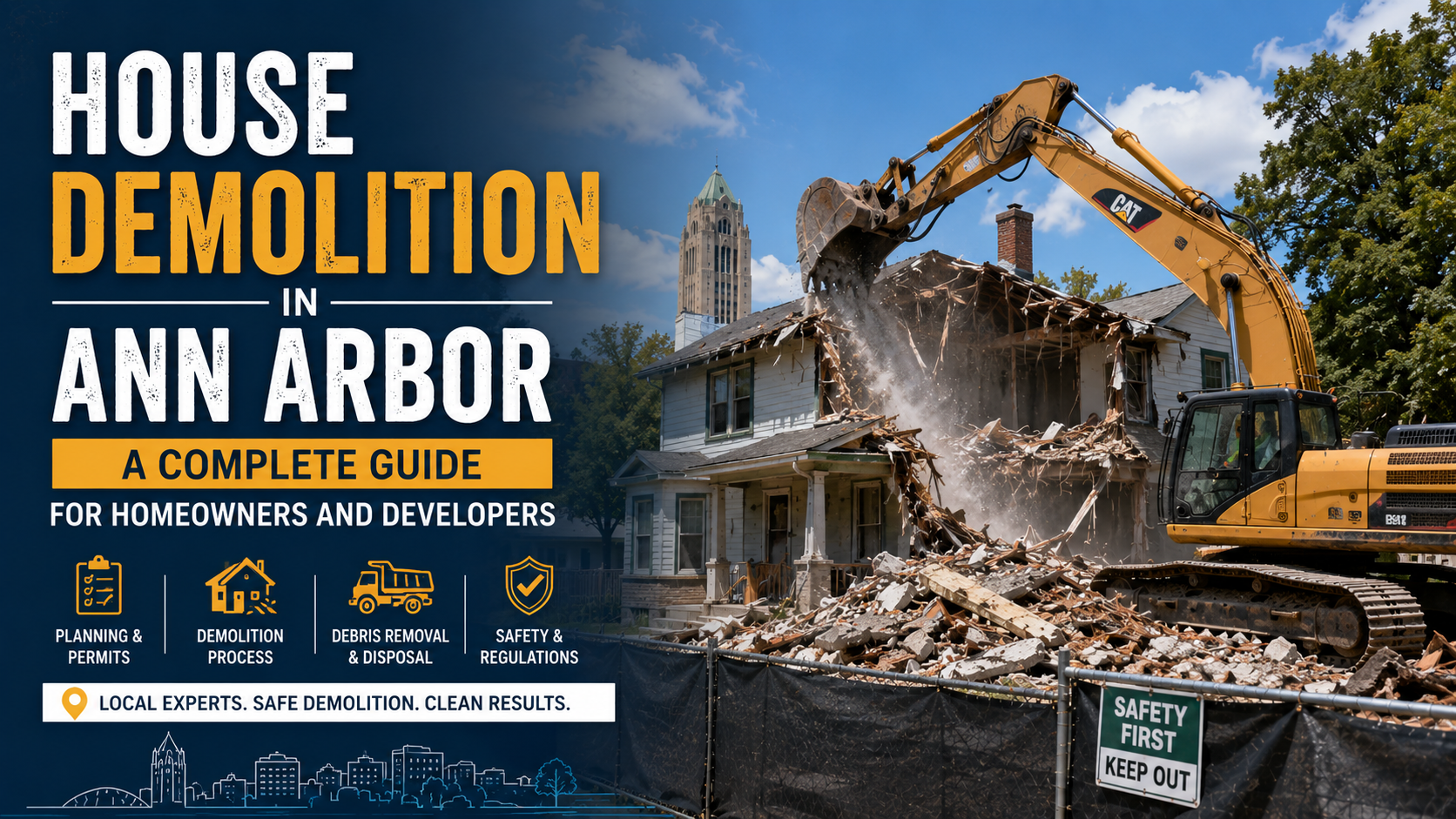
Total House Demolition Ann Arbor is the complete removal of all above-grade structure, including the roof, walls, and in most cases the foundation. Total demolition is typically performed mechanically, using an excavator to break and remove the structure in a controlled sequence. For most standard residential structures in Ann Arbor, total mechanical demolition can be completed in one to three days, with additional time required for debris loading and removal. The resulting site is typically graded level and ready for the next phase of development.
Partial or Selective Demolition removes specific portions of a residential structure a garage, a wing, an addition, or an outbuilding while leaving the primary structure intact and habitable during and after the work. This type of demolition requires considerably more care and precision than total teardown, as the interface between what is being removed and what is remaining must be managed to protect the structural integrity and weatherproofing of the portion being kept.
Residential Deconstruction is the deliberate, manual disassembly of a home with the goal of recovering and salvaging as much reusable material as possible. Structural lumber, flooring, cabinetry, doors, windows, plumbing fixtures, and architectural features can all be extracted intact for donation or resale. Some Ann Arbor-area organizations specialize in accepting salvaged residential building materials. Deconstruction typically takes several weeks compared to the days required for mechanical demolition, but it significantly reduces landfill waste and may be preferred by property owners with sustainability priorities or a desire to donate materials to affordable housing projects.
Permits and Regulatory Requirements
House demolition in Ann Arbor requires a building permit from the City’s Planning and Development Department, located at 301 East Huron Street. The permit application requires information about the property, the demolition method, and the contractor’s licensing details. Ann Arbor’s typical permit processing time is approximately three weeks, though this can vary based on project complexity and current department workload. Submitting a complete, accurate application with all required documentation is the most reliable way to avoid delays.
Properties within Ann Arbor’s Historic District require additional review before a demolition permit will be issued. The Historic District Commission evaluates demolition requests for structures within locally designated historic districts, and applicants may be required to demonstrate that alternatives to demolition have been considered. This process can add meaningful time to the pre-demolition schedule and should be anticipated early in project planning.
For projects involving the full teardown of a residential structure, the City of Ann Arbor also requires that water and sewer service disconnections be arranged through the Ann Arbor City Water Utilities before demolition begins. Gas and electric disconnections must be coordinated with DTE Energy. These utility disconnections can take two to three weeks to process, so they should be initiated concurrently with the permit application not after the permit is received.
Michigan’s asbestos regulations require that any structure scheduled for demolition be inspected by a licensed asbestos inspector before work begins. If regulated asbestos-containing materials are identified, they must be abated by a licensed contractor with written notification to the State of Michigan at least ten days before abatement commences. Michigan also requires a post-abatement air monitoring check to verify that abatement has been successful before demolition can proceed.
Asbestos and Other Hazardous Materials
Ann Arbor has a significant stock of older residential buildings. Homes built before 1980 may contain asbestos in floor tiles (particularly the 9-inch vinyl tiles common in mid-century construction), ceiling tiles, pipe and duct insulation, popcorn ceiling texture, roofing materials, and joint compounds. Homes built before 1978 may contain lead-based paint on interior and exterior surfaces. Both materials require specific handling procedures during demolition to protect workers, neighbors, and the environment.
A licensed asbestos inspector can survey a home quickly and comprehensively before demolition begins. If asbestos is found, the abatement process typically takes a few days to a week depending on the quantity and type of material involved. Lead-based paint does not always require removal before residential demolition, but workers must be protected during the process and lead-contaminated debris must be managed appropriately.
Homes that have been affected by flooding a concern that is relevant in parts of Washtenaw County subject to Huron River basin flooding may also contain mold in wall cavities, framing, and insulation. Mold remediation is separate from asbestos abatement but may need to be addressed before demolition to protect the health of demolition workers and neighbors during the work.
The House Demolition Process
A standard residential demolition project in Ann Arbor begins with an on-site assessment by the demolition contractor. This evaluation covers the size and construction of the structure, the site’s access for equipment, the proximity of neighboring structures, any known hazardous material conditions, and the underground utility configuration. This information informs the demolition plan and the equipment selection.
Following the hazardous material assessment and, if required, abatement, the permit application is submitted and utility disconnections are arranged. With all pre-work complete and permits in hand, the mechanical demolition phase begins. An excavator is the primary piece of equipment for most Ann Arbor residential demolitions, using a grapple or bucket attachment to systematically break down the structure from the roof down through the walls and to the foundation level. Debris is loaded into trucks or roll-off containers as the work progresses.
The foundation is addressed according to the project requirements. If the lot is being prepared for new construction, the foundation is typically broken out and removed, and the resulting void is backfilled with clean material and compacted. If the project scope does not include foundation removal, the remaining concrete is generally left in place or crushed and distributed as fill.
The site is then graded to a clean, level condition, with topsoil spread if required. Final inspection by the City of Ann Arbor closes out the demolition permit. In most standard residential demolition projects, the entire process from equipment mobilization through debris removal and site grading takes between two and five days.
Recyclability of Residential Demolition Materials
Residential demolition generates materials that can be significantly diverted from the landfill through recycling. Steel from roofing, appliances, and structural elements is fully recyclable. Concrete from foundations and flatwork can be crushed and reused as aggregate. Clean wood framing and dimensional lumber can be chipped for mulch or, in the case of salvage demolition, reused directly. Brick and masonry are often reusable in landscaping and construction applications.
An experienced demolition contractor in Ann Arbor maintains relationships with local recycling facilities and knows which materials have recycling value, approaching each project with a disposition plan that minimizes unnecessary landfill disposal. This is both environmentally responsible and, in many cases, financially advantageous.
Ann Arbor’s Residential Demolition Context
Washtenaw County’s soil conditions particularly the clay-heavy soils common across much of the Ann Arbor area influence how residential demolition sites are managed. Clay soils can make equipment access challenging in wet conditions and may require specific grading and drainage planning after demolition to ensure the site manages surface water properly. The Huron River watershed, which passes through and around Ann Arbor, also means that sites near drainage channels are subject to soil erosion and sedimentation control requirements, particularly during the Michigan spring when precipitation is high and soils are saturated.
A demolition contractor with deep familiarity with Ann Arbor and Washtenaw County one who has worked on properties in neighborhoods ranging from the established older streets near downtown to the newer developments and larger-lot properties out toward Dexter and Chelsea brings practical knowledge of local soil conditions, drainage patterns, and site management requirements that translates directly into better project outcomes.
Final Thoughts
House demolition in Ann Arbor is a regulated, multi-step process that requires professional expertise, proper licensing, and careful attention to the City’s permit requirements and Michigan’s environmental regulations. Whether you are removing a deteriorated structure, clearing a lot for new construction, or beginning a large-scale residential development, understanding what the process involves helps you plan your project realistically and work effectively with your demolition contractor. The result a clean, properly prepared site ready for its next chapter is the foundation of every successful residential development or rebuilding project in the Ann Arbor area.